It is now day 3 of 3 for the 2022 Cheyenne Gaming Convention. The afterparty at Flippers Family Arcade was amazing. But no rest for the weary, at least not yet. The first thing on Sunday’s to-do schedule was Dungeons and Dragons Adventurers League. So what is Adventurers League you may be asking? According to my understanding, in a very simple nutshell, it’s pickup D&D similar to pickup basketball. You some basic characters, a single session adventure, and the players. Each player gets a character and you play through the adventure, generally one and done.
My Adventurer League group was supposed to start at 0800 with a dungeon master named “Outlaw Mike.” In a situation I am sure many DnD players can relate to, nobody else for the group showed up. Instead, myself and Mr. Mike joined and Raymond, Tim, and Michael, to play a game under dungeon master Kari. The adventure had us trek through the Moonshae Isles to deal with Bheur hag. Translated from DnD terminology, we were stuck on an archipelago and had to kill an old witch.
I think it is safe to say that I was the younger player there by at least 10 years, maybe 15. Being the newest player, I also had the weakest character. Slightly irritating but it was alright. On the upside, I had the pleasure of getting the killing blow on the hag and using my new dice set and dice box from Strange Fate Crafts. I also gained some inspiration for a couple of characters I could play in more casual, long-running games.
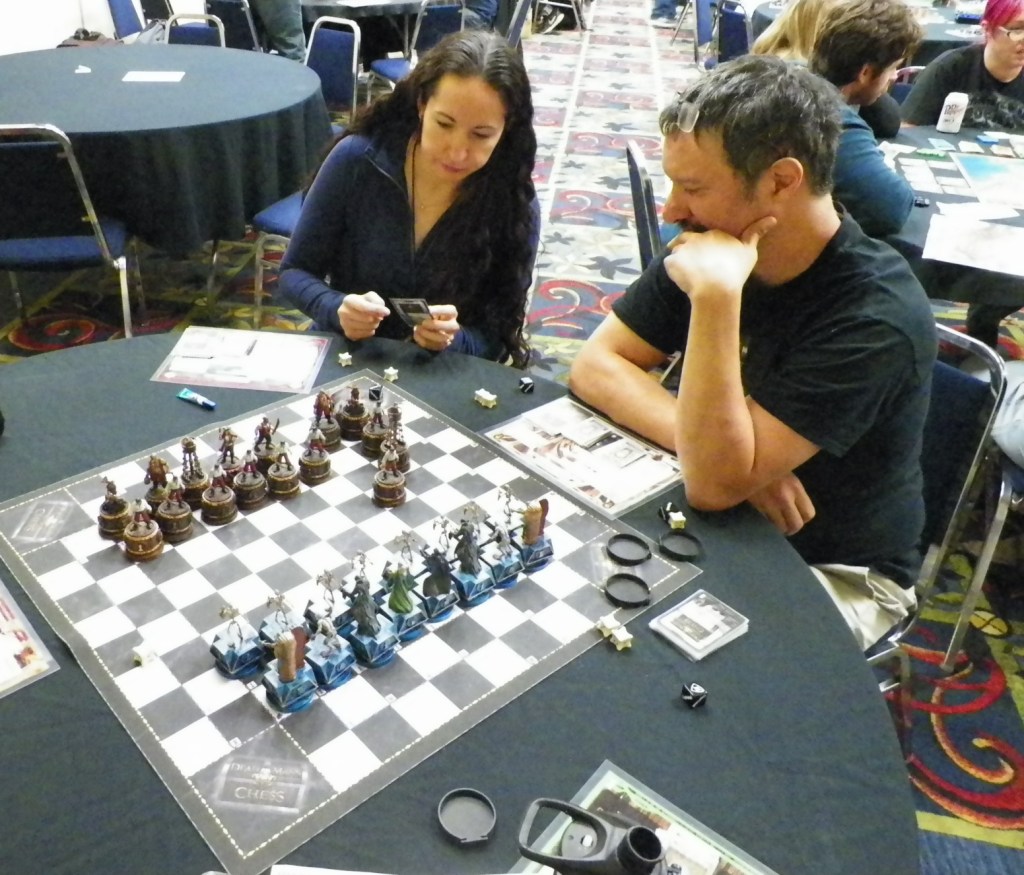
The game lasted about four hours. After completion, I returned to the board game ballroom at the back of the convention hall. My goal there was twofold. First, I was going to try and record the last big game of Oathen and get practice with video. Second, I wanted to try my hand at a game called Dead Man’s Chess which interested since day one of the convention. A bonus to doing a feature about Dead Man’s Chess was that one of the designers was also the game master for the podracing event the night before: Mr. Virgilio San Andres

Dead Man’s Chess is being published by Spyglass Games and has two parts to its gameplay. The first is an actual chess and strategy element. You take turns moving pieces around a board with the intention of capturing your opponent’s pieces. Capturing them is important and beneficial, just not straightforward. The teams also happened to be themed around different factions such as Pirates and Vikings.
Along with game pieces, each faction comes with a placard describing the special abilities they have and three small card decks. Two of these decks grant buffs to either specific pieces or the whole group. The third deck, which we will call the “movement deck,” allows for pieces to be moved in non-standard chess motions. You cannot interrupt your regular movement or your card movement with the other. You must play one movement option all the way through, then do the other. Whichever comes first does not matter.
Maybe for some better illustration, let me run through an imaginary round. It is the second round of the game and its pirates vs. undead. I control the pirate faction and it is also my turn. To begin my turn, I roll a six sided dice to see if my abilities activate, which they do not. Then I draw from my movement deck. The card I draw allows me to move a knight and a pawn in the same turn. I decide to use this movement first and clear some space. I move a pawn two spaces up and a knight closer to the center of the board. For my regular movement, I shift a bishop from its starting spot to the edge of the board. I discard my movement card and end my turn.
Now it is my opponent’s turn. His movement card allows him to move a knight twice. He does so, them moves it a third time to attack the pawn I just moved. This is the second element of Dead Man’s Chess: luck. In regular chess, you can just take an opponent’s piece. In Dead Man’s Chess, you have to roll for it. Each kind of piece has an attack modifier and defense modifier. Players use d6 dice, add the piece’s appropriate modifier and determine who has the higher number.
Unfortunately for me in this hypothetical round, pawns do not have great bonuses. It does not help that I rolled a two on the d6, so my opponent wins the first roll off. On the slim chance that I had won, I would have captured his knight instead. There’s still hope though. Now I roll a special d6. One of this dice’s sides is a shield icon. If I do land on the shield, the attack ends in a draw and nobody loses a piece. No such happenstance though. So the bad news is that I lose a pawn. The good news is that his knight is now staring down the barrel of my rook. And it’s my turn again.
So far, these blogs about the CGC have averaged out to about 1,145 words each. This written episode will have to be a bit shorter. A lot of work must to be done to get the next part ready. So tune in for part 6 when I finally showcase some Oathen and a game system on the edge of existence.
 James Meyer